
Why Bald-Faced Hornets Love Evergreen Trees and Privacy Screens
If you’ve ever walked past your arborvitae hedge or cedar privacy screen and heard that deep, papery hum coming from somewhere inside — you already know something is wrong. Bald-faced hornets are aggressive, territorial, and they have a real preference for dense evergreen plantings. Understanding why they nest where they do is the first step to getting rid of them safely.
This isn’t a pest you want to ignore until fall. By the time most people spot a nest, the colony is already hundreds of workers strong and fully capable of sending a person to the hospital.
They’re Not Just “Big Wasps” — Here’s What Sets Them Apart
A lot of people confuse bald-faced hornets with yellow jackets or paper wasps. They’re actually more closely related to yellow jackets, but their behavior is distinctly more aggressive. They’re larger, they defend their nests in force, and unlike bees, they can sting multiple times without dying. One disturbed nest can result in dozens of stings in a matter of seconds.
Their nests are the grayish, football-shaped paper structures you’ve probably seen photos of online or in your neighbor’s tree. What most people don’t realize is how fast those nests grow. A colony that starts with a single overwintering queen in early spring can contain 400 to 700 workers by late summer. By the time a homeowner notices something unusual in their privacy screen or hedgerow, the colony has usually been building for weeks or months.
That’s the part that catches people off guard — the nest is hidden long before it becomes a problem you can see.
So Why Do They Keep Nesting in Evergreens and Privacy Screens?
Bald-faced hornets are drawn to locations that offer three things: concealment, structural support, and protection from wind and rain. Dense evergreens — arborvitae, spruce, juniper, Leyland cypress — check all three boxes at once. The tight, layered branching gives them anchor points to build from, and the year-round foliage keeps the nest completely hidden from view until it’s grown far too large to ignore.
Vinyl and wood privacy fences with lattice panels, climbing vines, and dense hedgerows along property lines work the same way. The nest grows inward and upward, invisible until someone trims the hedge or walks too close to the wrong spot. In Jackson, Michigan, a lot of residential properties have exactly this kind of landscaping along fence lines and property borders — which is part of why hornet calls are so common here from July through September.
Here’s what makes this especially tricky for homeowners to deal with on their own:
- Bald-faced hornets will attack anything they perceive as a threat within three feet of the nest
- They release an alarm pheromone when disturbed, which signals other workers to join the attack almost immediately
- Nests located near entryways, play areas, or anywhere dogs and kids spend time create genuine safety hazards long before anyone makes direct contact
If you’ve had issues with yellow jackets entering homes, the response instinct is similar — don’t swat, don’t spray blindly, and don’t try to handle it yourself mid-day when the colony is most active.
Mid-Season Discovery Is the Worst-Case Scenario for DIY
Most people find these nests in July or August, which is exactly when the colony is at peak population. That timing matters. Hardware store sprays are designed for small, exposed nests treated at night — not for a 600-worker colony buried inside six feet of tightly packed arborvitae or hidden behind a lattice fence panel.
The nest location inside dense vegetation makes it nearly impossible to soak thoroughly on the first attempt. A partial treatment doesn’t eliminate the colony — it just makes the workers more defensive and more likely to sting anything that comes near the area over the following days. That’s a worse situation than what you started with.
Professional pest extermination in Jackson handles this completely differently. A licensed technician assesses the nest location, the colony size, what’s around the area, and how accessible the planting or structure is before deciding on an approach. Sometimes that’s a direct injection treatment at night when workers are clustered inside. Sometimes larger or more concealed nests require a follow-up visit to confirm full elimination. The goal is always complete colony removal, not just surface disruption.
This is one of those situations where doing it right the first time saves a lot of pain — literally.
Does the Nest Just Go Away After Summer?
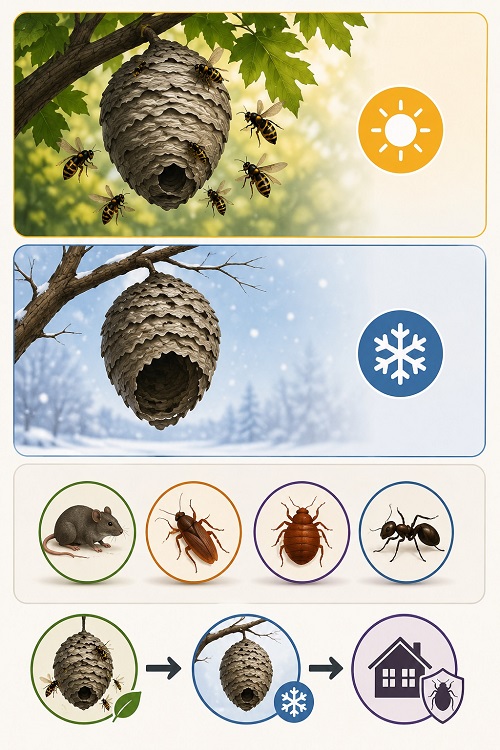
Technically, yes. Bald-faced hornet colonies die off each winter, and they never reuse the same nest. The queen overwinters elsewhere and starts a completely new colony the following spring. So if you wait long enough, the problem resolves itself.
But waiting until the first hard freeze in Jackson means leaving an active, aggressive colony near your fence line, back patio, or driveway for another two to three months. That’s a long time to avoid part of your own yard. And the dead nest left behind over winter can attract other insects and pests once the structure starts to break down in spring.
The smarter move is treating it while the season is active. If you’ve been dealing with other pest pressure indoors at the same time — mice finding entry points, cockroach activity in the kitchen, bed bugs showing up in a bedroom, or ants coming in through the foundation — it’s worth bringing that up when you call. A lot of Jackson homes deal with multiple pest issues simultaneously during the warmer months, and combining a hornet treatment with a broader pest control inspection saves time and money compared to scheduling separate visits. Our post on summer preventative pest control breaks down exactly why this time of year is when proactive treatment pays off the most.
What Professional Hornet Removal Actually Looks Like
When you call for hornet pest control in Jackson, Michigan, here’s what the process typically looks like from start to finish.
First, an inspection. The technician locates the primary nest, checks for any secondary nests nearby that may have gone unnoticed, and looks at what’s around the area — foot traffic, proximity to doors and windows, landscaping layout, that kind of thing. It’s not just about the one nest you called about.
Treatment follows, usually in the evening or early morning when workers are least active and the colony is clustered together inside the nest. For nests inside dense evergreen plantings or behind fencing, the method and product used depends on how accessible the nest actually is. A technician will explain the approach before anything is applied.
After treatment, you’ll get a clear picture of what to expect over the next 24 to 48 hours — including whether a follow-up is needed and what signs to watch for. Full colony elimination from a mature nest inside thick vegetation sometimes takes more than one visit, and a reputable pest extermination company will be upfront about that.
Service areas include Jackson, Lansing pest control services, Kalamazoo pest control, Battle Creek, Coldwater, and surrounding mid-Michigan communities.