
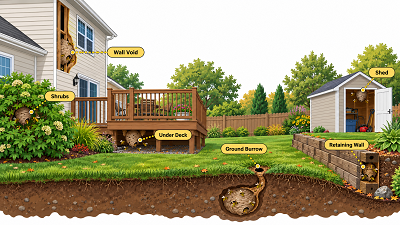
Yellow Jacket Nest Locations Common in Residential Yards
Most people discover a yellow jacket nest the hard way. You’re pushing the mower along the back fence, or pulling weeds by the porch, and suddenly the ground seems to boil. We hear this story every single week from late July through early fall, and honestly, it never gets less painful to hear.
The good news? Yellow jackets are predictable. They like certain spots, and once you know what to look for, you can usually find a nest before it finds you. Our crew has spent years on yellow jacket pest control calls across mid-Michigan, and this is what we’ve learned about where they set up shop.
The Ground Beneath Your Feet Is Prime Real Estate
Here’s something that surprises a lot of homeowners: many yellow jacket nests are underground. The queen doesn’t dig much herself. She moves into a hole that already exists, usually an old chipmunk tunnel, a vole run, or a gap under a landscaping rock.
That’s why ground nests often show up in the same yards where rodents have been active. If you’ve dealt with burrows along your foundation or in the garden beds, those empty tunnels are open invitations. It’s one reason we sometimes pair yellow jacket work with mice pest control. Clear out the rodents, and you remove a lot of future nesting sites.
Watch for a small hole, about the size of a quarter, with a steady stream of wasps flying in and out. No mound, no big dirt pile. Just traffic.
Walls, Soffits, and the Gaps You Never Noticed
Older homes in Jackson and Lansing tend to have a few loose pieces of siding, a cracked soffit, or a gap where the utility line enters the house. To a yellow jacket, any of those looks like a front door.
Once inside a wall void, a colony can grow to several thousand workers before anyone realizes it’s there. Sometimes the first clue is a faint chewing or crackling sound behind the drywall. Other times it’s a dark, damp spot on the ceiling.
One important piece of advice: please don’t seal the entrance hole. It feels like the logical move, but trapped yellow jackets will chew in the only direction left to them, which is often straight into your living room. Knowing what to do indoors becomes especially important if workers have already started appearing inside the house.
Other Spots We Check on Almost Every Visit
Our technicians have a mental checklist they run through at every property. These are the places that turn up nests again and again:
- Under decks, porch steps, and low patios
- Inside hollow landscape timbers and retaining walls
- Thick shrubs and overgrown hedges near the house
- Sheds, detached garages, and covered grills that sit unused for weeks
- Kids’ playsets, especially plastic slides and hollow tube frames
- Woodpiles, compost bins, and stacked lumber
If a spot is sheltered, dry, and doesn’t get disturbed often, it’s fair game.
Why September Feels Like an Ambush
Early in the summer, a yellow jacket colony is small and busy raising young. By late August and September, that same colony is at its biggest, and the workers’ appetites shift toward sugar. Suddenly they’re crashing backyard cookouts, circling soda cans, and getting defensive about anything that comes near the nest.
That’s why so many of our Battle Creek and Lansing calls stack up this time of year. The nest didn’t appear overnight. It’s been growing quietly for months, and now it’s hard to ignore.
The upside is that nests don’t last through a Michigan winter. Only new queens survive, and they leave to find a sheltered spot to wait out the cold. Old nests aren’t reused. That doesn’t necessarily prevent recurring summer wasp problems if your property continues offering good nesting conditions. And if the colony is next to your back door right now, waiting for the first hard frost isn’t much of a plan.
Found One? Ask Yourself This First
Is the nest somewhere people walk, kids play, or pets roam?
If the answer is yes, it’s worth getting help. Yellow jackets can sting repeatedly, and a disturbed ground nest can send dozens of them after you at once. Anyone with a known sting allergy should keep well clear. The risks of DIY removal are especially important with active ground nests, since store-bought sprays often reach only the entrance, which tends to just make the colony angry.
What Happens When You Give Us a Call
We start by talking with you about what you’ve seen and where. Then a technician comes out to inspect the property, confirm it’s actually yellow jackets, and identify the differences between stinging insects when necessary. Sometimes it’s a different wasp or even bees, which need a different approach. We also locate every active nest, not just the one you spotted.
Treatment usually goes directly into the nest entrance, often with a dust product that workers carry deeper into the colony. Most activity drops off within a day or two. For nests we can safely reach, we’ll remove them. If something’s inside a wall, we’ll explain your options and what to watch for over the following days.
And if activity doesn’t settle down? Call us. We’d rather come back and make it right than leave you guessing.
Yellow Jacket Pest Control for Jackson, Lansing, and Battle Creek Homes
Yellow jackets are just one piece of what we handle. Our team also provides bed bug pest control, cockroach pest control, mice pest control, and full-service pest extermination for homes throughout mid-Michigan. Whatever’s bugging you, we’re a local crew that picks up the phone and actually shows up.
If you’ve spotted a nest, or you just have a bad feeling about that hole by the fence, reach out and we’ll take a look.
Schedule Bed Bug Treatment Today
Contact us today for help with bed bugs.
Don’t let a small infestation become a major problem. Patriot Pest Control offers reliable bed bug extermination in Jackson, MI, designed to restore comfort and peace of mind.