

Carpenter Ants vs Termites in Residential Homes
You found a pile of what looks like sawdust under the window sill. Or maybe a few winged bugs showed up on the basement floor one warm afternoon in May. Either way, the question running through your head is the same one we hear on the phone almost every week in spring: is this carpenter ants or termites?
It’s a fair question. Both insects go after wood, both love Michigan’s damp springs, and both can do real damage when left alone. But they behave differently, they leave different clues, and the treatment for each one isn’t the same. Knowing which you’re dealing with is the first step toward getting it fixed.
Big Black Ants Indoors? Don’t Shrug That Off
Most homeowners in Jackson and Lansing have seen a large black ant wander across the kitchen floor. One ant isn’t cause for panic. A steady trail of them, especially at night or early in the season, usually is. That’s also why Michigan ant problems increase so noticeably as temperatures climb.
Carpenter ants don’t actually eat wood. They chew through it to build nests, pushing the shavings out as they go. That’s the “sawdust” people find, and if you look closely, it often has bits of dead insects mixed in. Termites, on the other hand, really do eat the wood. They digest the cellulose, and they’re quiet about it. Many people never see a termite until the damage is already done.
Carpenter Ants vs Termites in Lansing-Area Homes: How to Tell Them Apart
Swarmers are the easiest place to start, since both insects send out winged members in spring. Here’s what our technicians look for:
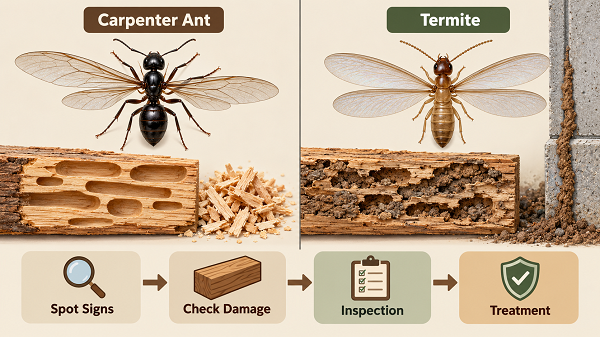
- Waist: Carpenter ants have a pinched, narrow waist. Termites are thick through the middle, almost tube-shaped.
- Antennae: Ants have bent, elbowed antennae. Termite antennae are straight and beaded.
- Wings: Termite wings are all the same length and fall off easily, so piles of discarded wings near windows are a big clue. Ant front wings are noticeably longer than the back pair.
- Debris: Ants leave frass (coarse shavings) outside the nest. Termites leave mud tubes running up foundation walls.
Still not sure? Snap a photo and send it over. We’d honestly rather look at a blurry picture than have you guess wrong.
What the Wood Itself Is Telling You
Crack open damaged wood and the difference gets clearer. Carpenter ant tunnels are smooth, clean and almost polished, like someone sanded them. Termite galleries are rough and packed with mud and soil.
Moisture is the common thread. Leaky gutters, a soft window frame, a deck post sitting in wet soil. Understanding how moisture attracts carpenter ants can help explain why certain areas of a home become vulnerable. Both pests are drawn to wood that’s already softening, which is why we spend as much time on the “why here?” question as the “what is it?” one.
Can This Wait Until Next Season?
We get it. Nobody wants another bill. But a mature carpenter ant colony can have thousands of workers and satellite nests tucked into walls you can’t see. Termite colonies work around the clock, every month the ground isn’t frozen. Waiting rarely makes the job smaller.
The good news? Caught early, both problems are very manageable, and preventative summer pest control can help identify vulnerable conditions before insect activity becomes more obvious.
Your First Visit: What to Expect
When one of our technicians comes out, they’ll walk the outside of your home first. Foundation, siding, rooflines, woodpiles, anywhere water collects. Then they move inside to check the basement, crawlspace, attic access and the spots where you’ve noticed activity.
You’ll get a straight answer on what’s going on, what we recommend, and why. No scare tactics. If it turns out to be something minor, we’ll tell you that too. We’ve had plenty of “termite” calls end up being a harmless ant species that just needed a little outdoor treatment.
After Treatment, Here’s What Happens Next
For carpenter ants, you may see a bit more activity for a few days as the treatment works its way back to the colony. That’s normal, and it’s actually a good sign. Termite treatment focuses on creating a barrier and eliminating the colony, followed by monitoring to make sure nothing sneaks back.
We’ll also point out the moisture problems or wood-to-soil contact that invited them in. That can include recommending steps for preventing ants in decks and other exterior wood structures. Fix those conditions, and you’ve made your home a lot less appealing to the next wave.
Pest Extermination Across Jackson, Lansing and Battle Creek
Wood-destroying insects are only part of what we handle. Plenty of our customers first called about ants and stayed with us for full-home pest control. We do bed bug pest control for families and rental properties, cockroach pest control for kitchens and apartments, and mice pest control once the Michigan cold pushes rodents indoors every fall. In late summer, yellow jacket pest control keeps backyard cookouts from turning into a sprint for the door.
Our team lives here. We know how Michigan’s wet springs and freeze-thaw cycles affect local homes, and we know which neighborhoods tend to see termite pressure and which ones deal more with carpenter ants. That local experience shapes every inspection we do.
Seeing sawdust, winged bugs, or mud tubes? Give us a call and we’ll help you figure out exactly what’s moved in, and how to get it out for good.
Schedule Bed Bug Treatment Today
Contact us today for help with bed bugs.
Don’t let a small infestation become a major problem. Patriot Pest Control offers reliable bed bug extermination in Jackson, MI, designed to restore comfort and peace of mind.