
Hornet Nest Removal From Mature Shade Trees
That big shade tree in your backyard was supposed to be a place to relax — not something you have to circle around in a wide arc just to get to the garage. If a hornet nest has taken up residence in the branches overhead, you already know how quickly that changes things.
Hornet nest removal from mature shade trees is one of the more common calls we get here in Jackson, Michigan — especially through late summer when colonies are at full size and hornets are at their most defensive. Our hornet control services are specifically designed to address these large established colonies safely. It looks manageable from a distance. It rarely is.
Why Shade Trees Are a Top Target for Hornet Nests
Hornets are deliberate about where they build. Mature shade trees give them what they want: structural support from older branches, canopy cover that protects the nest from rain, and enough height to avoid frequent disturbance. A paper wasp or bald-faced hornet colony can grow to several hundred or even a few thousand workers in a single season, and by August, that nest tucked up in your oak or maple is a serious problem.
The issue isn’t just the hornets themselves. It’s the location. When a nest is 15 or 20 feet off the ground in a tree you actually use — for shade, for kids playing underneath, for pets — you can’t just wait it out. A nest that size will stay active until the first hard frost.
So what’s actually living up there? In Jackson and surrounding areas, we typically see:
- Bald-faced hornets (the large black-and-white ones, often building those gray paper globe nests)
- European hornets (bigger than yellow jackets, active at night, sometimes surprising people after dark)
- Yellow jackets nesting in hollow sections of older trees or in root systems at the base
Yellow jacket pest control is its own category entirely — underground colonies and hollow-tree colonies behave differently and require a different approach than an above-ground paper nest. Problems involving yellow jackets indoors are often an entirely different situation requiring immediate attention.
Is It Safe to Handle This on Your Own?
Short answer: usually not, and here’s why it matters more than people expect.
Climbing anywhere near a bald-faced hornet nest, or disturbing one from below with a spray, triggers a coordinated defensive response. These aren’t solitary insects making a judgment call — the whole colony mobilizes. Multiple stings happen fast. For anyone with an allergy, that’s a medical emergency. Even for people without a known allergy, a large nest in a tree can deliver enough stings to cause a serious reaction.
Store-bought hornet spray is designed for small nests within arm’s reach. It isn’t built for a mature colony 18 feet up a silver maple. And if the treatment doesn’t fully eliminate the colony on the first attempt — which is common without professional-grade materials — the hornets become even more aggressive.
This is the part where experience genuinely matters. Working with wasp removal experts dramatically reduces the risk of multiple stings and incomplete treatments.
What Happens When You Call Us
We don’t just show up and spray. Here’s how the process actually goes:
First, we assess the situation. The species, the nest size, how high it is, what’s around the tree (structures, foot traffic, kids’ play areas) — all of that shapes how we approach it. A ground-level yellow jacket nest in a tree root system gets handled very differently than a paper hornet globe 20 feet up.
Then we treat it properly. We use professional-grade pest extermination products that aren’t available over the counter. Timing matters too — treatment at the right time of day, when the majority of foraging hornets are back in the nest, makes the process significantly more effective.
We follow up. A successful treatment means the colony is eliminated, not just disrupted. If follow-up is needed, we come back.
Most jobs are resolved in a single visit. You’ll know before we leave what to expect over the next 24 to 48 hours, and we’ll tell you honestly if a return visit makes sense.
What About the Nest Itself — Does It Need to Come Down?
This is one of the questions we get most often, and the answer depends on a couple of things.
An old, inactive nest won’t re-house a colony. Hornets don’t reuse prior-year nests — each spring, new queens start fresh somewhere new. So a gray paper globe that’s been dead since October is largely cosmetic. It will deteriorate on its own over time, and removing it from a high branch often creates more risk than it’s worth.
That said, if the nest is low enough to safely access, if it’s positioned where it could fall and create a mess, or if it’s causing genuine anxiety for your family using the yard, we can discuss removal as part of the service. We’ll give you an honest recommendation rather than padding the job.
We Handle More Than Hornets
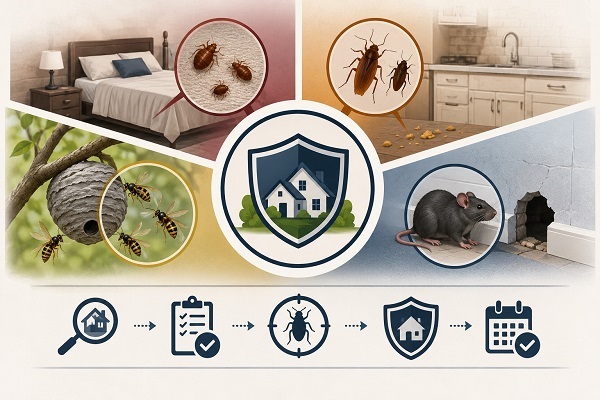
Hornets are what brought you here, but pest problems rarely stop at one species. Homes and properties in Jackson, Michigan deal with a full range of pest pressure across the seasons:
Bed bug pest control is one of the more sensitive and technically involved services we offer — bed bugs are not a DIY situation, and a missed treatment means they come back.
Cockroach pest control requires understanding the species and the entry points, along with identifying hidden food sources that allow infestations to persist. German cockroaches behave differently than American cockroaches, and a spray-and-pray approach won’t solve the underlying problem.
Mice pest control follows the same logic — sealing entry points matters as much as trapping. A mice infestation that keeps coming back usually means there’s a structural gap that hasn’t been addressed.
Whether it’s hornets in your shade tree, yellow jackets coming out of your foundation, or something else entirely, the approach is always the same: figure out what’s actually happening before deciding how to handle it.
A Note on Timing — Don’t Wait Until Late Summer
Hornet colonies grow all season. A nest in May is a fraction of the size it will be in August. Earlier treatment is almost always easier, faster, and less disruptive than waiting until the colony is at full strength.
That said — we also know that people often don’t discover a nest until someone nearly walks into it. Whenever you find it, call us. We’ve handled nests at every stage of development and in some genuinely inconvenient spots.
Serving Jackson, Michigan and Surrounding Areas
We’re a local company, not a national franchise. That means you’re talking to people who know the area, know the pest pressures that come with Michigan’s seasons, and are actually going to show up when we say we will.
Have a hornet nest you’re not sure about? Give us a call at (517) 740-5115 or reach out through the website. We offer free inspections, and we’re happy to take a look and tell you exactly what you’re dealing with before any work begins.