Pest Control for New Apartment and Multifamily Developments
Building something new is exciting. Whether you’re a developer breaking ground on a 20-unit complex or a property manager taking over a brand-new multifamily building, the last thing you want to deal with is a pest problem before the first tenant even signs a lease. But here’s the reality — new construction isn’t automatically pest-free. In fact, some of the conditions created during and after a build are exactly what pests are looking for.
This page is for developers, property managers, and building owners who want to get ahead of pest issues before they become expensive, reputation-damaging problems.
Why New Construction Attracts Pests More Than You’d Think
There’s a common assumption that brand-new buildings don’t have pest problems. That’s not quite how it works.
During construction, soil gets disturbed, food waste from crews accumulates, and the building itself sits open to the elements for months. Mice, ants, cockroaches, and even yellow jackets can establish themselves inside wall voids, under slabs, and in utility chases before a single resident moves in. Once the building is sealed up and climate-controlled, those pests have everything they need — warmth, shelter, and soon enough, access to food as tenants settle in.
And once residents arrive? The complexity multiplies fast.
The Pest Pressure Specific to Multifamily Buildings
Managing pest control in a single-family home is one thing. A multifamily development is a different animal entirely. You’re dealing with shared walls, interconnected plumbing, common areas, laundry rooms, trash rooms, and dozens of individual units — all of which create pathways for pests to spread from one tenant’s space to the next.
Here’s what tends to show up most often in apartment and multifamily settings:
- Cockroach pest control issues are common in kitchen and utility areas, especially where plumbing penetrations weren’t properly sealed during construction
- Bed bug pest control becomes a real concern the moment residents start moving in — particularly if tenants are bringing secondhand furniture or coming from other infested properties
- Mice pest control is often needed when exterior gaps, loading dock areas, or ground-floor utility entries weren’t sealed before occupancy
- Yellow jacket pest control becomes urgent in summer when nesting occurs in soffits, rooflines, and landscaping features around the property
The earlier these are addressed, the less likely they are to spread between units. That’s why pre-occupancy pest control and an ongoing service agreement make so much more sense than waiting for a complaint.
What Happens When Bed Bugs Get Into a New Development
This one deserves its own section because it’s the pest problem that causes the most tenant panic — and it spreads faster in apartment buildings than almost anywhere else. One infested unit can lead to multiple units being affected within weeks, especially if the building has soft flooring, shared laundry, or common corridors.
bed bugs in apartment buildings — and once they’re established across multiple units, the treatment scope and cost grow significantly. Getting ahead of this during move-in season with a preventative protocol is far less disruptive than treating an outbreak after the fact.
Cockroaches Don’t Wait for Move-In Day
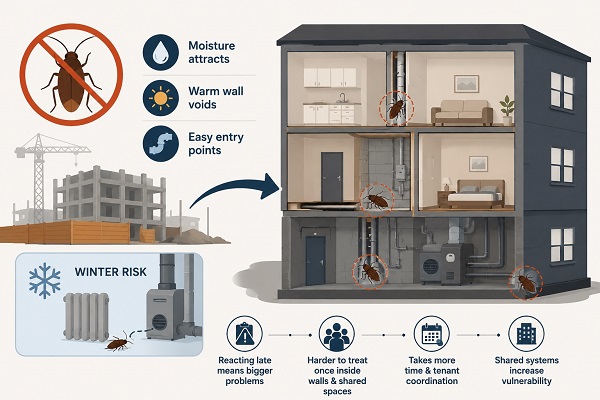
Cockroaches are drawn to moisture and warm wall voids — two things that exist in abundance during and right after construction. Pipe chases, unfinished utility rooms, and even gaps around HVAC systems are common entry points.
A building that gets treated reactively after cockroaches are reported by residents is one that’s already behind. The pest extermination process in a multifamily setting takes longer when infestations are established in walls and shared spaces, and it typically requires coordination with multiple tenants to be effective. Cockroaches near radiators and furnace rooms during Michigan winters is a well-documented problem — and multifamily buildings are especially vulnerable because of shared mechanical systems.
So What Does Pre-Occupancy Pest Control Actually Look Like?
Good question. Here’s how it typically works when a developer or property manager brings us in before residents move in:
Step 1 — Inspection and Entry Point Assessment
We walk the building before occupancy to identify any active pest activity, construction-related entry points, and high-risk areas like trash rooms, utility corridors, and ground-level entries.
Step 2 — Initial Treatment
Based on the inspection, we apply targeted pest control treatments to common areas, utility spaces, and any units showing signs of activity. This isn’t a spray-and-leave situation — it’s methodical and focused on where pests actually live.
Step 3 — Ongoing Service Agreement
Most developers and property managers opt for a recurring service schedule once the building is occupied. This keeps common areas treated, catches any new activity early, and gives your maintenance team a point of contact when a tenant reports something.
Does Every Unit Need to Be Treated?
Not necessarily — but it depends on what the inspection finds. In some cases, treating common areas and the ground floor is sufficient as a preventative measure. In others, particularly if construction took longer or the building sat unoccupied for a season, we may recommend treating individual units as well.
The honest answer is that every building is a little different, and the right approach comes from actually walking the property — not from a one-size-fits-all package.
Questions Property Managers Should Be Asking
Are gaps around utility penetrations sealed in every unit? Has the trash room been treated before move-in? Is there a protocol for what happens when a tenant reports pests? Do lease agreements include cooperation clauses for pest control access?
These aren’t just operational questions — they’re the things that determine how manageable pest issues will be once residents are in the building. Having answers to these before the first move-in date puts you in a much stronger position.
Serving Jackson, Michigan and Surrounding Areas
Construction activity around Jackson has been steady, and so have the calls from property managers dealing with pest issues that started during the build phase. Serving the greater Jackson area means understanding the local pest pressures — the species that are common here, the seasonal patterns, and the specific challenges that come with Michigan’s winters and summers.
Whether you’re managing a brand-new 50-unit complex or a smaller multifamily property that just opened, pest control for new developments in Jackson is something we handle regularly.
Ready to Set Up Service Before Move-In?
The best time to schedule a pre-occupancy inspection is before your first residents arrive — but we work with buildings at every stage, including properties that are already occupied and dealing with an active issue.
Give us a call or use the contact form to get started. We’ll ask a few questions about your building, schedule a walkthrough, and give you a straight answer about what’s needed — no pressure, no upsell, just honest pest control advice from people who do this every day in Jackson and the surrounding area.
Request a callback and we’ll be in touch within one business day.