Hornet Control for Horse Properties and Hobby Farms
There is a reason the biggest hornet nest in Jackson County always seems to end up on somebody’s horse property. Barns are tall, dry, and quiet. Run-in sheds have deep overhangs that never get rained on. Fence posts split and hollow out. And a manure pile or a water trough is a buffet of flies and sugar for a colony that needs to feed thousands of mouths by late summer.
Add in a few acres, a handful of outbuildings, and the fact that most folks only walk the back pasture once a week, and you can see how a nest goes from golf ball to basketball before anyone spots it.
We have been doing pest control for farms and acreage around Jackson, Michigan long enough to know that hornets on a hobby farm are not the same job as hornets on a suburban porch. Our professional hornet control services account for more ground to cover, more structures to check, and animals who cannot simply go inside when things get loud.
Where We Find Them on Jackson-Area Horse Properties
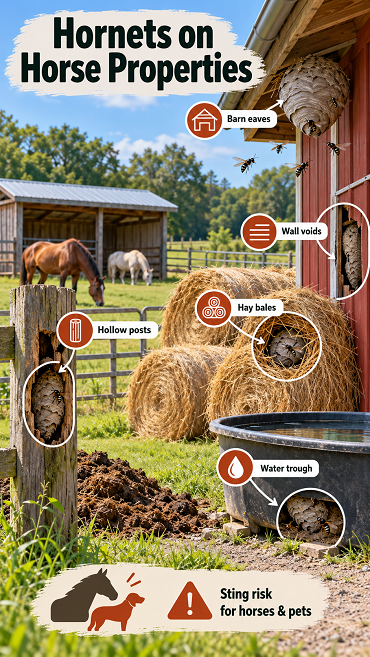
Ask any of our techs where they look first and you will get the same answer: up. Bald-faced hornets love the gable end of a hay barn and the underside of a lean-to roof. European hornets, the big brown ones, go for hollow spots.
An old oak along the fence line, a gap behind barn siding, the dead space inside a wooden feed bin. Knowing where hornets build nests helps explain why colonies sometimes settle dangerously close to busy stalls, walkways, and equipment areas.
A few places that surprise owners every single year:
- Inside the tack room wall, found only when someone hears the hum through the drywall
- Under the lid of a plastic water trough that has not been moved since spring
- Tucked into round bales stacked against the barn and left for the winter
- Behind the electrical panel in the run-in shed
Hornets are not shy about sharing space with a horse. The horse, on the other hand, has a strong opinion.
When a Sting Is More Than a Sting
A 1,200-pound animal that spooks at a hornet does not just get hurt. It can tear through a fence, go down in a stall, or throw whoever is on its back. We have had calls from owners whose gelding would not go near the wash rack for weeks because a nest sat right above it. Goats and chickens are not immune either, and dogs on a farm will absolutely bite at a hornet until they learn not to.
Then there is you. Mucking stalls at dusk puts your face about two feet from the eaves. Hornets defend their nest in numbers, and unlike a honeybee, each one can sting more than once.
So the question on a horse property is never really whether to deal with the nest. It is how to do it without anyone, two-legged or four-legged, paying the price.
Hornet, Yellow Jacket, or Something Else?
Half the time, the “hornets” we are called out for turn out to be yellow jackets. No shame in that, they are all stinging insects that mean business. But the treatment is different, which is why professional yellow jacket removal starts with identifying exactly what is nesting on your property.
Bald-faced hornets build that classic gray paper football hanging from a branch or an eave. European hornets are chunkier, reddish brown, and nest inside cavities.
Yellow jackets are smaller and sharper looking, and on a farm they almost always come from the ground, an old rodent burrow, or a gap in the siding.
If a stream of small yellow and black insects is pouring in and out of a hole near the base of the barn, that is a yellow jacket pest control job, and we treat it accordingly.
Not sure what you have? Snap a photo from a respectful distance and send it over. We will tell you what it is before we ever load the truck.
What Happens When Our Truck Pulls In
First thing, we talk. Where are the animals right now? Is there a paddock we can move them to for an hour? Which barn doors stay closed? Getting that sorted up front keeps everyone calm, especially the horses.
Then the walk. A hobby farm hornet job starts with every structure on the place, not just the one you called about. Hay barn, run-in, chicken coop, equipment shed, the old pump house nobody uses.
Checking hidden wasp nesting locations is also important because colonies can develop behind siding, beneath rooflines, and inside structural gaps.
One nest usually means conditions are right for another, and we would rather find it now than have you call back in August.
Treatment happens in the cooler part of the day when the colony is home and slow. We use products rated for use around livestock buildings and apply them directly to the nest, not sprayed across the aisle where your horse eats.
Aerial nests get treated and removed once they are dead. Cavity nests get treated at the entrance and then sealed so nothing moves back in next year.
Before we leave, you get a plain-language rundown of what we found, what we did, and what to watch for over the next couple of days. A few stragglers returning to a treated nest is normal. A fresh stream of traffic is not, and that is a phone call we want.
Keeping Them Off the Farm Next Year
Hornets do not reuse a nest, but a queen will happily build a new one fifty feet from the old one if the neighborhood still looks good. Spring is when she is scouting. Walk your eaves and overhangs in April and May, and knock down anything the size of a walnut while it is still just her.
A few habits make a real difference. Keep lids on feed bins and sweet feed sealed tight. Move the water trough once in a while so nobody sets up housekeeping under it.
Fix the siding gap you have been meaning to get to. And if the fly population around the manure pile is out of control, that is a hornet food source, so fly management is hornet management.
Most of our farm customers end up on a seasonal plan, and it is rarely just about hornets. A barn that feeds hornets also feeds mice, and mice pest control on a horse property is its own year-round battle.
Cockroach pest control comes up more than you would think in heated tack rooms and feed areas. We have even handled bed bug pest control in a bunkhouse used by seasonal help.
Full pest extermination across the property, timed to the Michigan seasons, beats chasing one emergency after another.
What happens next is simple. We note what we treated, flag what to watch, and set a time to check back. No pressure, no surprise contracts. If you want us out again, you call. If you want us on a schedule, we build one around your animals and your calendar.
Questions We Hear From Horse Owners
Do I have to move my horses out of the barn?
Usually just out of the immediate area for an hour or so. We will tell you exactly which stalls or paddocks need to be empty, and for how long.
Can I just spray the nest myself?
You can, and people do. The problem on a farm is scale and location. A nest twenty feet up on a gable end, or one buried inside a wall, is a different animal than a nest under the porch rail. One bad angle and you have a very angry colony and nowhere to run.
How fast can you get to Jackson, Grass Lake, or Spring Arbor?
Hornet calls on properties with animals go to the front of the line. Most of the time we are out within a day or two, and same day when a nest is somewhere people or horses are getting stung.
Will the treatment hurt my dogs or barn cats?
We treat the nest, not the barn. Keep pets clear while we work and for the short window we tell you afterward, and they will be fine.
If you are standing in the barn right now looking up at something you do not like, give us a call. Pest control for horse properties and hobby farms is a big part of what we do around Jackson, Michigan, and hornets are one job we would rather handle for you than have you handle alone.